Monday, November 25, 2013

Matrilineal Monday - Mary Ann McPherson McGregor (1861-1941)

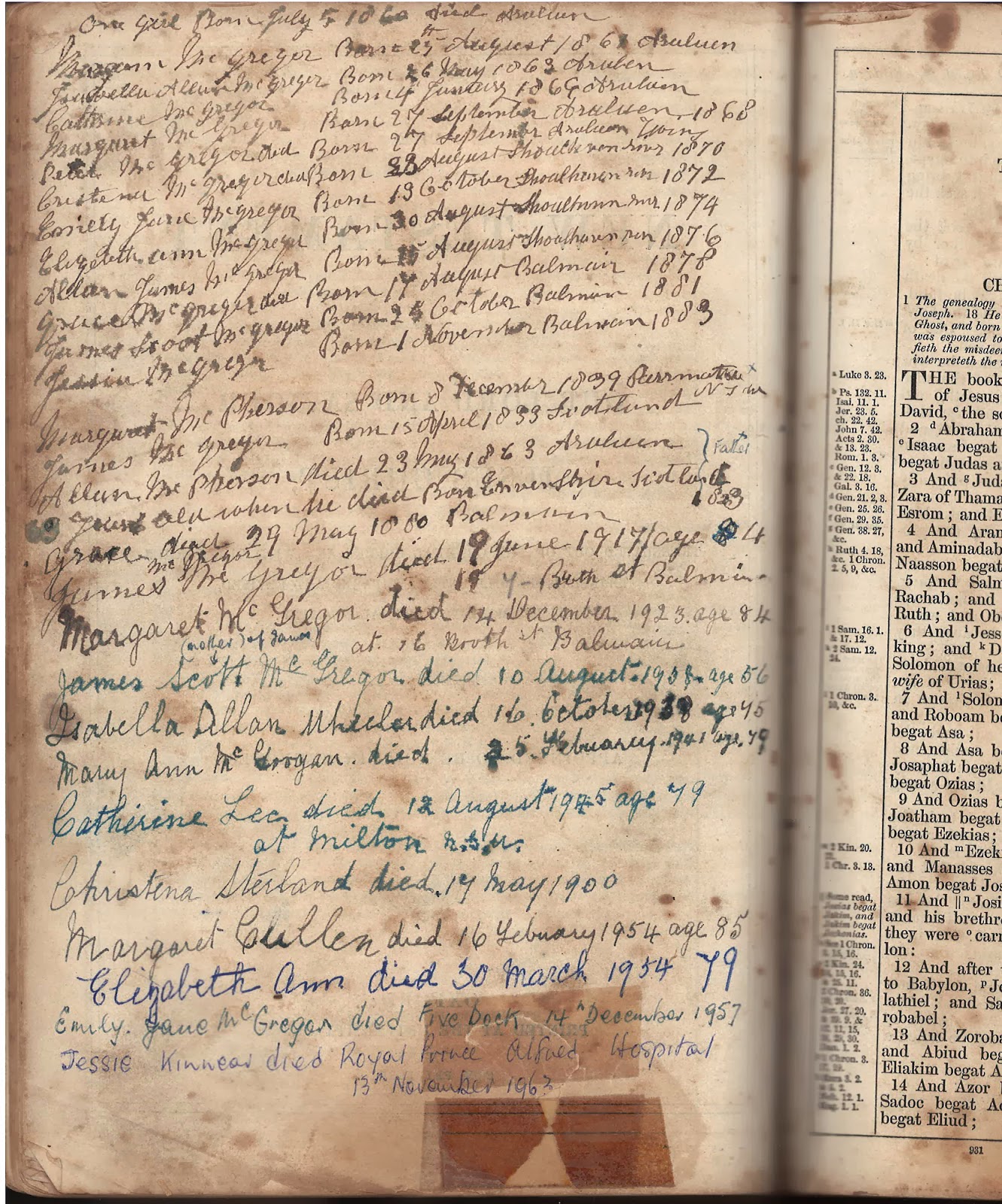
This is the first in a series of blogs about the daughters of James McGregor (1833-1917) and Margaret McPherson (1839-1860) - The McGregor Sisters. Interest in this project was sparked when I was recently given a photo of the McGregor Family by my Aunt. Then, as if to give the project a gentle push, two weeks later the Society of Australian Genealogists (SAG) contacted me advising that they had in their keeping James and Margaret's Family Bible. The Bible proved to be an invaluable find, as inside there was a hand written list of family events, including the birth dates and places of all the McGregor sisters. Writing and researching the story of each of the McGregor Sisters, will I believe, be a journey of discovery, and I hope it will lead to connections with others who are researching this family.

Mary Ann McGregor
Life on the Gold Fields

On the 27 August 1861,  James and Margaret's welcomed their daughter Mary Ann  McPherson McGregor. The family was living and working on the gold fields of the mining community of Araluen, in the Southern Highlands of NSW.  James and Margaret had lost their first child, a little girl at birth in 1860.  The gold mining in Araluen had started in 1851 and the district had become one of the most significant mining areas in New South Wales, with over 15,000 prospectors arriving to try their luck, and in excess of 11 million pounds of gold being extracted from the area.*

The winter of 1861 had been a harsh one with severe flooding devastating and causing havoc to vast areas of the mining community in the Araluen and Major's Creek fields. However, as winter passed life on the gold fields improved. Araluen was known as Happy Valley, one article written July 1861 (just prior to Mary Ann's) birth, states "Araluen - We were much pleased on Saturday last, in paying a visit to the Happy Vally to find that the greatest prosperity prevails throughout the entire diggings; all the claims are realizing satisfactory returns,......The diggings are now rapidly extending along the Plain towards the Farm and this part, it is anticipated, will turn out extremely rich when it comes to be thoroughly worked.  it is really refreshing to see the happy state of affairs in the valley compared with what was the case a few months ago, when devastation and ruin had laid wast nearly all the claims." Braidwood Dispatch**

Entry in Family Bible for Mary Ann McGregor - 25 August 1867
Mary Ann and her family continued to live in the mining town of Araluen until 1870.  The family bible shows the family then lived at Shoalhaven River until around 1877, when James and Margaret packed up their belongs and moved their family to Booth Street, Balmain Sydney.  Mary Ann would have been around 16 years of age at this time.  One has to wonder, how the McGregor sisters adapted to life in the city after spending most of their childhood in the country.

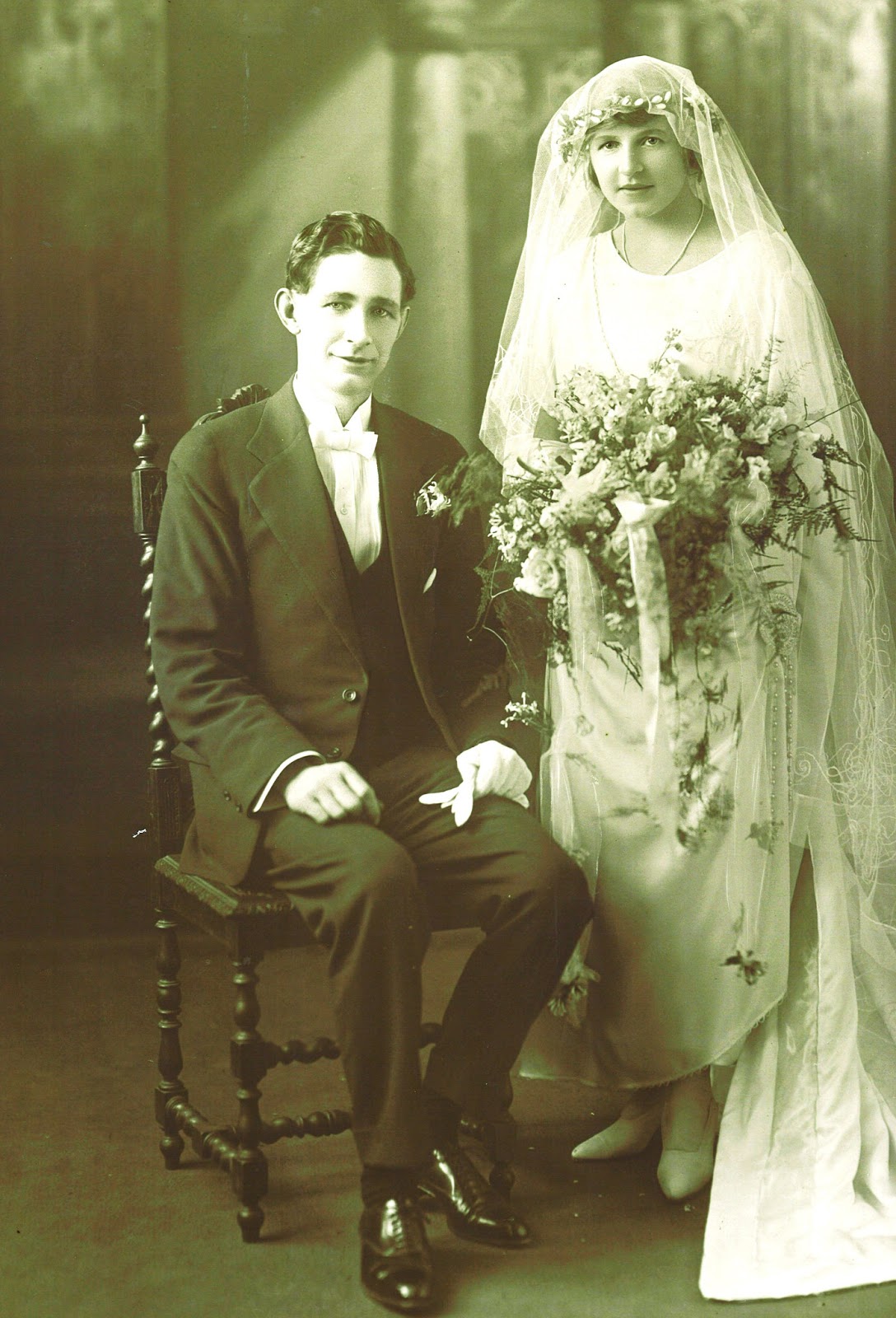
On August 14 1884 Mary Ann married Hugh James McGoogan, in Balmain.  Hugh and Mary Ann continued to live  and raise their family in Sydney.  Their children were: Margaret Mavis, John, James, Hugh and George.

At the age of 80 Mary Ann passed away peacefully while staying with her daughter. Her husband Hugh passed away the following year. 

Entry in McGregor Family Bible  for the death of Mary Ann McGoogan (nee McGregor)


______________
*Australian Heritage   http://www.heritageaustralia.com.au/search.php?state=NSW&region=103&view=729, viewed 22/11/13.
**1861 'GOLD FIELDS.', Freeman's Journal (Sydney, NSW : 1850 - 1932), 27 July, p. 3, viewed 25 November, 2013, http://nla.gov.au/nla.news-article115763269.


Tuesday, November 19, 2013

Wordless Wednesday - The McGregor Family Bible

List of family bdm in the McGregor Family Bible
Yesterday I wrote about my trip to the Society of Australian Genealogists,  (Lunchtime Discoveries in the Rocks - McGregor Family Bible) following one of their volunteers conacting me about James and Margaret McGregor's Family Bible.  What a coincidence, that this has happened as I start on my project to put together the stories of of James and Margarets daughters.

The timing is remarkable, especially the discovery inbetween the New and Old Testament of a page that lists the details of the McGregor Sisters births, deaths and marriages.

McGregor Bible - Family BDM entries


Monday, November 11, 2013

Matrilineal Monday - The Ladies of the McGregor Family

Every now and then,  all family tree researchers come across a small item, whether it be a letter, photo, postcard or newspaper clipping that opens the door to some  new and exciting family links. This was my fortune a couple of weeks, when visiting an Aunt.  We were comparing notes on our family tree, and she gave me a copy of the photo (above)  of Margaret and James McGregor surrounded by their children, spouses and grandchildren. 

Margaret McPherson married James McGregor on 23 June 1859, at the Presbyterian Church,  Jinglemoney, NSW. Margaret and James had a large family of three boys and nine girls.   How amazing was it to have access to this photo of the family which has each member of the family identified.

I spent the whole of our 4 hour trip home from my Aunt's place (luckily my husband was happy to drive) searching on my Ipad, and filling in gaps on my online family tree.  This picture gave me so many clues, most importantly the married names of the McGregor women.

This new stream of information has opened the door to my next project for The Other Half of My Tree - stories of my female ancestors, and over the next few weeks I shall attempt to write about each of the McGregor sisters.


Sunday, March 24, 2013

Fearless Females - Aunty Tilly (Matilda Holman -nee Taylor) 1900- 2001

Matilda Marion Taylor

 Over the past month I have been enjoying reading the blogs by Lisa Alzo, The Accidental Genealogist , Fearless Females, in honour of National Women’s History Month, and the other blogists who have also joined to tell the stories of the Fearless women in their family tree.  As this theme fits so well with the central theme of my blog The Other Half of My Tree - stories of my female ancestors, I thought I should honour some of the women from my family tree with the title of Fearless Females. 

The first to spring to mind was my husbands great Aunty Tilly. I was privileged to meet her in her later years, and found her to be an amazing lady.  There are many stories that highlight her independence, stubbornness, resourcefulness, charity and acceptance of others. Tilly was the grand daughter of Elizabeth Taylor (nee Rushworth)  and she certainly mirrored the tenacity of her grandmother living for over 100 years, and even into her late years  was continually involved in community organisations.

Taylor Family
Matilda Marion Taylor was born on the 14 November 1900 to Richard Taylor and Marion Millar McNair.  Her parents hand immigrated from England and Scotland (respectively) in the late 1870’s. They met and married at St Peters Church, Marrickville on the 1st August 1981. 

Matilda was the fifth child born, her siblings were William (1892-1976), Elizabeth Annie (1894-1896), Richard (1895-1965), Jessie (1898-1975). Unfortunately, her oldest sister Elizabeth drowned on the family property at the age of two. Her youngest brother Robert (1905-1981) was born when she was five. In the late 1920's the family moved from Arncliff to Moon's Avenue, Lugano, in the Marrickville area.


Tilly (RHS) in school uniform with sister Jessie

Tilly's (as she liked to be called) father Richard was a stone mason.Tilly  attended St George High School. She was a bright student and  went on to study at the Sydney Teachers’ College. Following her graduation in 1920, she was appointed to the teaching staff of the Brewarrina School in far western NSW. This posting must have presented quite a few challenges to the young girl who had been brought up in the city. 

Brewarrina was about 800 kms north-west of Sydney and was very much a frontier town, with very few amenities. In these times young teachers were expected to take on postings in the country and most took it in their stride as part of the learning process.  On one of my visits to Aunty Tilly’s house in Cowra I remember her relating the story of her first weekend in the town of Brewarrina.One of the local pastoralist's sons took her and another new teacher on a trip out into the country side to show them a little of the surrounds.  Unfortunately, there was a mishap with the car’s fan belt and the young gentleman had to ask if one of the ladies would mind providing one of their stockings to make up a makeshift fan belt to get them home.  Her face was so funny when she told the story, reminiscing on an event that she considered a little risqué.

At about the same time as Tilly moved to Brewarrina, her future husband, Harold Vincent Holman, moved to Gunnedah (just over 400 kms away) to take up the position of Town Clerk.  Harold was a WWI veteran, who had joined the army at the age of 16 and was shipped to Europe to serve in France.  When he returned from the war he studied to become a town council officer and his first posting was in Gunnedah.  During this time, despite the distance between Gunnedah and Brewarrina Tilly and Harold met and courted each other.

Harold and Tilly Holman
Three years later,(1923) they were married in Marrickville, Sydney and moved to a small village outside of the NSW town of Dubbo, called Geurie.  During their time here, Tilly and Harold were blessed with three children, Vincent, Harold and Joan.  Shortly after Joan's birth in 1928 Harold was appointed Town Clerk at Cowra. Harold remained this position until his retirement. 

Soon after their arrival in Cowra, Harold and Tilly build a home in 2 Carleton Street, Cowra and this house remained as Tilly’s home until she reluctantly agreed it was time to move into a nearby nursing home, (at the age of 99). Even though Tilly had her hands full with a young family, and settling her husband into his new position as Town Clerk, she quickly became involved in many local community affairs, joining the local Red Cross, which she remained an active member for the rest of her life. Harold was very active in the returned soldiers affairs and Tilly was keen to follow his interests in helping ex-serviceman, particularly those who fell on hard times during the long years of the Depression.  In 1987 Tilly received the Red Cross Long Service Medal with first and second bars and then in 1990 she received the Red Cross laurel wreath for 50 years service.  

Tilly's insatiable appetite for community involvement had her next join the Country Women's Association and the Hospital Auxiliary and she worked for both until quite recent times. In 1939 she was elected president of the Church of England Ladies' Guild and joined the Croquet Club, serv­ing as a committee member for many years. When the Second World War broke out and the military training camp was established near the town, Tilly added to her activities by joining the Women's Voluntary Service and on most days attended their shop and then worked in the canteen during the evenings, preparing food and giving support to the many soldiers who passed through the town. 

 Her 'spare' time was spent on the back verandah of their home, knitting for those who were posted overseas. With both of her sons in the Boy Scouts, Tilly found time to keep their uniforms in top condition and to provide food and drink for the many who called at her home.  After the war, Tilly assisted in the formation of the Cowra Meals on Wheels service and remained actively involved until 1980. In later years, she became a thankful recipient of its ben­efits. She also found time to help form the Cowra branch of the RSL Women's Auxiliary and was its president between 1948 and 1951, remaining: a member until her death. She also helped form the Torch Bearers for Legacy in Cowra, was its first president and later was made a life member

Tilly and Family
A continuing interest in education had her send her three children to private schools, to complete the last two years of their high school education. Vince and Harold want to St Patrick's in Goulburn, which was renowned for its strong discipline, and Joan to St Catherine's in Sydney. In 1956 Tilly became a Foundation Member of the Cowra Women's Bowling Club and undertook a range of responsibilities on its executive committee for many years, including its secretary, later vice-president and its Official Delegate to the National Conferences. She was elected a Life Member in 1971. Her love for sport was never diminished and although a diminutive woman, she played a fair game of golf in the years before the war and later became devoted to bowling and the many social activities that came from membership of the club.

She relished the annual bus trips to Melbourne to attend the Melbourne Cup and joined in the many activities on the way. She continued to make the annual bus trip to Melbourne until she was in her late 80's.  Her husband and three children predeceased her, but her days of sadness quickly passed as she found comfort in her countless activities, many friends, and her pet dog, cat and budgerigars. The grandchildren and their children became a vital part of her life and she took every opportunity to visit them and to enjoy their company. She thought nothing of travelling 100's of kms for a family event. Sometimes she travelled by air and on others by bus and train. She was quite undaunted by the difficulties old people encounter as they attempt to climb in and out of vehicles and find their way around in the push and shove in getting from place to place, but if in any trouble, she had no hesita­tion in asking, sometimes demanding, that a passing stranger provide the necessary assistance. Having to leave her pets behind could have been a hin­drance to her many trips but neighbours were brought into play and, willingly or not, agreed to mind them until she returned.

Aunty Tilly in her later years.
Before the war, her husband kept a car in the little shed behind their home, which was a joy for his children's friends to inspect and, if not seen, to climb into and admire the brass fittings and imagine driving it away. Tilly didn't learn to drive until quite late in life and rarely went on her own, which may have been a blessing in disguise, as she was always very positive in her dealings with others, never considering that what she wanted was difficult or impossible to deliver, and if that had been trans­lated to the road, to often it could have created problems. She handed in her licence when she turned 80 and joined the Senior Citizens' Club, probably believing she could help the younger members, and ten years later the Arthritic Club, which awarded her Grandmother of the Year in 1992. 

AuntyTilly Holman was an quite a local icon.  She gave an enormous amount to the community, never wanting or expecting any recognition or benefit.  She always accepted people for who they were, without any prejudice or bias.  It would not be possible to count the number of people who in some way or another benefited from her work. When she reached her late 90's she realised that it was becoming too difficult for her to live by herself, so she agreed to move into a Nursing Home.  She was the proud recipient of a letter from the Queen when she reached 100 years.  It was not long after this that Aunty Tilly passed away in 2001.

Tuesday, March 12, 2013

Emma Jane Weston (1839-1914) - Life on the Gold Fields and more

Emma Lee (nee Weston)
After journeying from London to the penal colony of Sydney, Australia with her sister Mary Ann, Emma traveled to the gold fields near the small rural town of Braidwood where is thought she may have been in domestic service for the Maddrell Family.  At the age of 18 she married Thomas George Lee, who was one of the many hopeful miners looking for his fortune on the goldfields at Majors Creek, near Braidwood. 

 As Emma was under age permission to marry was given by Robert Maddrell Esquire, Legal Guardian and her sister Mary Ann Weston was one of the witnesses.Thomas and Emma's settled into life on the goldfields, their first son George was born on in December 1858.  Unfortunately George did not  live to see his first birthday.  In the next couple of years two more children, George William and Henry Thomas were born.

Majors creek, was originally a shanty town  that grew up on the site of Elrington's village. The site comprised of stores, sly grog shops and miners tents.  Life was tough not the best environment for women.  In 1851 a police outpost was established.  The gold takings at Majors Creek were originally aluvial with reef mining starting in the late 1860-70's.  We cannot be sure of the reason but sometime between 1862 and 1864 Thomas and Emma left Major's Creek, crossing Clyde Mountain and settling in the small settlement of Nelligen on the Clyde River where Thomas became the local store keeper.


In 1854 the first track was opened from Braidwood across the Clyde Mountain to the small settlement of Nelligen. In the same year the town of Nelligen was official gazetted.  During its early history some alluvial gold was discovered, however the town became more significant as a trading post.  Bringing in goods to be taken over the Clyde Mountain to the mining and rural settlements around Braidwood, and in return receiving timber, wool and gold from this area to be shipped up to Sydney.  Large steamers some up to 10,000 tons traveled up to Nelligen to pick up produce and deliver supplies and equipment to be carried over to the Braidwood district.


Perhaps Thomas Lee recognised that Nelligen was a better environment to raise a family, and that setting up a business as the local storekeeper in this thriving community was a much better option than trying his luck on the gold fields. The 1872 Greville's Report for Nelligen lists Thomas Lee as the Nelligen Store Keeper.  Emma would have been kept busy caring for their children as well as assisting in the store.  Their first daughter Emma was born in 1864 and in the coming years seven more children  (Thomas, Ellen, Albert, Susan, Hannah, Maude and Annie) were born bringing the number of children to ten.  The children attended the local school, which had to be rebuilt after the floods of 1867. In 1874 there were 18 children attending the local school, among these students were Nelly (Ellen), Thomas and Emma Lee.*  Their older brothers George and Henry would have been 14 and 13 at that time and were probably working in the family business.


Clark Brothers
These times were fraught with dangers, besides frequent flooding and bush fires, this was also the period when Bushrangers were very active in the district.  Ben Hall's gang were active on the road between Braidwood and Nelligen in 1865.  Two members of this gang were the notorious Clarke brothers, Tom and John.  The Clarke brothers hid out in the Jingera Ranges preying on the coaches travelling from the goldfields through to Nelligen.  In 1866 the brothers were responsible for the ambush  and killing of a special police gang. In 1867 the brothers were finally captured and taken by coach from Braidwood to Nelligen to be taken by steamship to Sydney.  The brothers were shackled to the "prison tree", which is still stands in Nelligen, prior to their shipment to Darlinghurst goal and subsequent hanging in 1867. Emma and Thomas Lee were witnesses to this event, and I remember my father telling me the story of the Clarke Brothers capture as it had been passed down through our family. 
  
The Lee family settled into the Nelligen district, with Emma and Thomas's children, going to school, marrying and having their families.  Even though, there were many difficulties including the isolation, floods and bushfires, I think Emma would have found the scenic rural environment of life on the Clyde River a pleasant place to raise her family.   

A brief description in the Australian Town and Country Journal in 1897 describes the settlement of Nelligen as: 

 NELLIGEN.
Nelligen is a pretty little town, situated on the south bank of the river. It has two sawmills, one public house, a couple of stores, etc. It has a few small farms and orchards along the course of the Nelligen Creek, and is only fourteen miles distant from Brimbrarnalla Gold Field. It has a coach road to Braidwood, Bateman, and Milton. It is at the head of deep water navigation, and should eventually become an important place as the auriferous resources of the district become developed.
 
In the later decade of the nineteenth century Thomas and Emma purchased "Acacia Farm" , a picturesque farm about 6 miles from Nelligen, on the banks of the Clyde River.  This farm stayed in the farm for the next four generations of the Lee family. On the first of November 1906 Thomas passed away at the age of 74.  Emma continued to live on Acacia Farm with her eldest son George and his wife Catherine (nee McGregor) and their children.

Five years later Emma, passed away at the age of seventy five, on the 21 July 1914.  Her death was reported in the Sydney Morning Herald,

death: Lee - July 21, 1914, at Nelligen, Clyde River, Emma J., relict of the late T. G. Lee, Aged 75. 1914 'Family Notices.', The Sydney Morning Herald (NSW : 1842 - 1954), 22 July, p. 12, viewed 1 October, 2012, http://nla.gov.au/nla.news-article15524286

 The young housemaid who had arrived from London at the age of 17 with her sister Mary Ann had certainly witnessed and experienced life to the full in the new colony.  
________________
*Reynolds, G.T. (1985), The History of The Port of Nelligen, Part 1, Batemans Bay Commercial Printers, Bateman's Bay.

Tuesday, January 29, 2013

Mary Ann and Emma Jane Weston continued


Mary Ann's Story

My last post finished with my great great grandmother Emma Jane Weston and her sister Mary Ann arriving in Sydney Harbour on board the "Kate" at Christmas time in 1856 under the sponsorship of their uncle Alfred Weston.  Before I continue with the story of my great great grandmother Emma Jane Weston, I thought would write a little about her sister Mary Ann.

I presume that the two sisters would have been met by their uncle Alfred Weston who had arrived in Sydney in the previous year, or it is possible that they travelled by stage coach to Wollongong where their Uncle was living at the time. There was a great shortage of labour in the country, especially female servants and as the passenger list for the "Kate" lists Mary Ann and Emma's occupations as housemaids from London, it could be assumed that they sought work as domestic helpers.

The next record that I can trace for the two sisters is Emma's marriage to Thomas George Lee (1832-1906) on the 22 February 1858 at St Andrews Church in Braidwood, New South Wales.* Thomas's occupation was listed as a miner from the gold mining area of Major's Creek which was in the Braidwood district.

WC- William Pronger and Mary Ann Weston
Mary Ann was listed as one of the witnesses to the wedding, and as Emma was still under the age of 21, permission to marry was given by Robert Maddrell Esquire, Legal Guardian.  Robert Maddrell was one of the "landed gentry" in the Braidwood district who lived on "Mona" and "Bedervale".  It is  possible that Mary Ann and Emma had come to the gold mining district of Braidwood/Araluen with their Uncle Alfred Weston and had gained employment with the Maddell family as domestic servants. (Some wonderful pictures of the Maddrell Family and their home can be found on the National Library Website at this link, http://catalogue.nla.gov.au/Record/3044367

Miners in Gold fields of Araluen, http://www.visitbraidwood.com.au/araluen
Six months later it was Mary Ann's turn to wed.  On the 19th August 1858** Mary Ann married William Pronger (1835-1917) a carpenter from Majors Creek.  Their wedding certificate states they were married in a temporary place of worship at Major's Creek under the rites of the Church of England. Mary Ann's uncle Alfred Weston is one of the witnesses at her wedding. Which leads me to believe the girls traveled with their uncle to the NSW mining district of Braidwood. Alfred Weston is listed in the Greville's Post Office Directory in 1872 as living in the mining town of Araluen and his occupation is listed as a miner

Life in the gold fields would have been a very different experience to that of their earlier life in London.  Majors Creek was one of the largest working mine fields in the 1850-1860's.  This short description from the blog "Major's Creek" gives a wonderful description of what life must have been like on the gold fields for Emma, Mary Ann and their husbands.

 "hundreds of men toiling away in the hot sun; panning, digging, pushing wheelbarrow. You hear the mix of accents: the broad drawl of the Australian born, the plums of English, Scot burrs, Irish lilts, European gutturals, languid American cadences and the staccato of Chinese.  

The hills are spotted with canvas tents and temporary structures of all shapes and sizes.  Clothes, in a rainbow of colours flutter in the breeze drying.

After sunset... the white canvas is replaced by the orange-red of camp fires.  The smell of cooking wafts up the valley.  As the evening deepens the loud voices, sounds of merriment and drunkenness escape from the windows of the lamp-lit hotels.  A male dominant place, stranger thrown together with diverse dreams, enjoying the euphoria of success and drowning the disappointment of failure."***
 
Floods in Main Street of Gympie 1870
Mary Ann and Emma continued living with their homes in the mining community of Majors Creek/Araluen, however, Mary Ann's husband William felt that it was time to move on and to seek his fortune in the newly discovered gold fields in Gympie, Queensland. 

Gold was discovered in Gympie by James Nash in 1867. I am not sure how William and Mary Ann travelled to Gympie, however the trip must have been long and fraught with many difficulties and dangers. I do not have the exact date that William and Mary Ann arrived in Gympie but I do know that in December 1868 William Pronger was appointed  by the Queensland Government to the position of the keeper of the Powder Magazine in Gympie**** He held this position until 1871 when he resigned to pursue other interests. *****.  In 1873 an article in The Queenslander advises that Pronger in partnership with Mr Rickett were operating a sugar refining mill and were turning out some good sugar. It seems that William Pronger was quite a pioneer and always looking for further opportunities.

Life would have been quite tough for Mary in this new gold mining town, in 1870 Gympie experiences severe flooding with many homes submerged. William and Mary did not have any children and from details on Mary's death certificate, Mary was in poor heath for some years. On the 7th July 1878, Mary passed away and the cause of death is listed as "ovarian dropsy" (in other words, from "ovarian cancer") which she had suffered from for over three years.  This could explain why she was not able to have any children.

On the 8th July 1878 William Pronger buried his young wife in the Church of England portion of the Gympie cemetery. 

William stayed in the Gympie district, becoming a successful business man.  He remarried in 1880 to Charlotte Elizabeth Drew they had a family of two daughters and three sons. Descendants of William and Charlotte still live in the Gympie district. 

As it is with many of our female ancestors, their story is told by researching their male relations and husbands.  Mary's story is a good example of this.  It is through her uncle Alfred Weston and her husband William Pronger's life stories, I have been able to piece together a little of her life story, from a house maid in London, to the gold fields in the southern highlands of New South Wales and then the journey of over 14,000 kms to the newly discovered mining outpost of Gympie, Queensland. I still have a lot of questions?  I wonder if she was able to see her sister Emma again after she left for Queensland? What kind of conditions did she live in when they first arrived in Gympie?  Was her home/tent flooded in the 1870 floods?  The list goes on and I guess these questions will probably never be answered.


_______
       * New South Wales Births, Deaths and Marriages, 1486/1858
     ** New South Wales Births, Deaths and Marriages, 1499/1858
    *** Majors Creek, http://www.majorscreek.org.au/content/history , viewed 18/1/2013
  **** 1868 'THE GAZETTE.', The Brisbane Courier (Qld. : 1864 - 1933), 7 December, p. 3, viewed 29 January, 2013, http://nla.gov.au/nla.news-article1323824
*****1871 'OFFICIAL NOTIFICATIONS.', The Brisbane Courier (Qld. : 1864 - 1933), 2 October, p. 3, viewed 29 January, 2013, http://nla.gov.au/nla.news-article1320642

Monday, January 28, 2013

Amanuensis Monday: Letter re Death of Elizabeth Taylor (nee Rushworth)

Elizabeth Taylor in her Nurses Uniform
Lucy and Joseph Hartley
This morning I was going through my file of family letters looking for some more information on Emma Jane and Mary Ann Weston when I came across a letter about the death of Elizabeth Taylor, so today I am allowing myself to be side tracked a little, as I would like to share this letter as a follow on from my previous posts on Elizabeth.  

The letter was written by Lucy Hartley (Elizabeth's daughter) to her brother Richard Taylor and his family.  Richard had immigrated to Sydney, Australia in the early 1880's. Though he had regular correspondence with his family in England, he had not seen his mother since leaving England. Two of his sons, Richard and William had been able to visit the family in Colne while they were on leave from the Australian Army in World War I. (Lucy mentions this visit in her letter).

The letter is very poignant and provide a wonderful completion to my Blogs Elizabeth, so please forgive my divergence back to previous posts.

62 Ackincoates Rd
Colne
Feb 13th 1927


Dear Brother Richard,

Just a few lines to let you know the sad news of Mother's death.  She had not been well for some considerable time, her strength gradually getting weaker and weaker until she could scarcely stand and finally she was compelled to take to her bed through sheer exhaustion, where she lay very patiently until the end came at 4.00, on Monday morning Jan. 31st.  She passed peacefully away in her sleep and her last words were - "Lord have mercy on us".  Matilda and I were present at the last and Father lay beside her, having just got off to sleep for a few minutes.

As you will see from the card we laid her reverently to rest in Colne Cemetery on Thursday same week, amidst many scenes of respect and honour and general regret in the town at the passing of her gentle soul.  We miss her very much now but must not grieve, for it is our loss but her gain.  A great worker, a kingly and sympathetic soul - no one appealed to her in vain for help if it was in her power to give, but above all - a good mother, she will be remembered for many years to come.

In future you must, address all your letters to our house, as we are breaking up the old home.  Father and Matilda are coming to live with us, as we shall be able to look after him better at our house, he has been here since Mother died and bears up very well considering their great attachment to each other when Mother was alive.

Our family will now consist of Joe and myself, our two children - Nellie (19) and Fred (9), Lizzie (19) - sister Lizzie's girl who came to live with us when her mother died 6 years ago, Grandad and Mathilda. Lizzie's boy is living with friends close by.

Father is fairly well considering his great age, but very deaf and rather bad on his props, but his appetite is fairly good, he sits nearly all the time in his chair and smokes his pipe and reads the newspaper, we think he will be now the oldest person in Colne.

I think we have now told you all the news so must now close, remember us to the boys, we often talk about them when they were here, we also hope and trust you are all keeping well.  We receive letters from Jessie and Tilly, also Dicks wife and the photo of John and his bride just came in time for Grandma to see - the week before she died. When is will going to be married, he does not seem to be in much hast about it, does he!

We all join in sending our love to you all and please remember the new address when any of your family write again,

Your affectionately Sister
Lucy and Joe Hartley